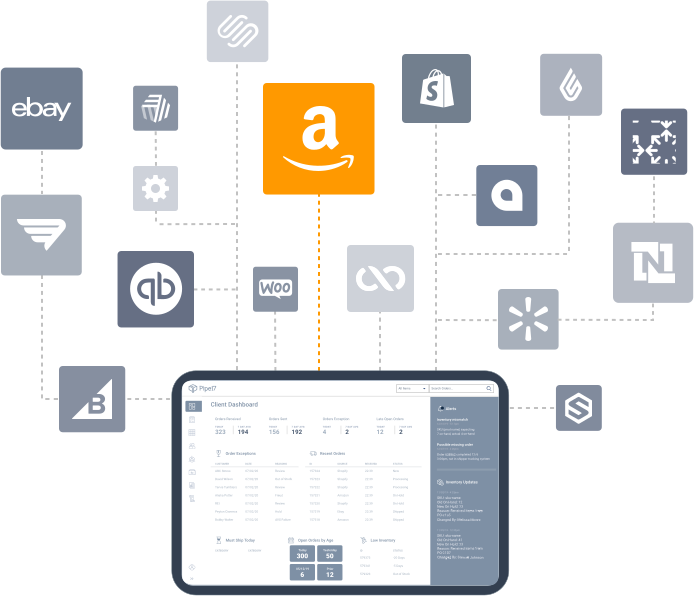
Managing FBM orders in one process, FBA inventory in another, and your Shopify store in a third creates operational complexity and makes it difficult to see the full picture of your business performance.
Without a unified inventory view, you can't list your FBA stock on your website or your warehouse stock on Amazon. This limits sales, and trying to do it manually leads to overselling.
Downloading Amazon settlement reports and trying to match them to orders in your accounting system is a time-consuming, manual process that delays your financial close.
| iPaaS & Custom Builds | Legacy OMS | Pipe17 | |
|---|---|---|---|
| Native API-First Connectivity | ✅ | ❌ | ✅ |
| Pre-Built Commerce Connectors | ❌ | ❌ | ✅ |
| Custom Integration Mappings | ✅ | ❌ | ✅ |
| Advanced Order Orchestration | ❌ | ✅ | ✅ |
| Exception Management & Alerts | ❌ | ❌ | ✅ |
| Unified Inventory Management | ❌ | ✅ | ✅ |
| Rapid to Implement & Go-Live | ❌ | ❌ | ✅ |
| Easy to Add / Swap Channels & Flows | ❌ | ❌ | ✅ |
| Low Total Cost of Ownership (TCO) | ❌ | ❌ | ✅ |
Instantly route FBM orders to your 3PL partners, WMS or ERP. Pipe17 automatically confirms shipment back to Amazon, helping you maintain excellent seller metrics. Process FBM orders 90% faster than manual methods.
Get a single view of all your inventory, whether it's in your warehouse, at a 3PL, or in an FBA fulfillment center. Safely sell your stock across all your channels without fear of overselling. Achieve 99.5% inventory accuracy.
Automate the process of sending inventory to FBA. Create shipment plans and send box content information directly from your WMS or ERP, without logging into Seller Central. Reduce FBA prep time by 75%.
is better with
Pipe17 integrates Amazon Seller Central through a single fully managed connector that links your account to your ERP, WMS, 3PLs, and other sales channels, running Amazon FBM (merchant-fulfilled) and FBA (Fulfilled by Amazon) as one operation. You authorize it with your Amazon credentials and choose which marketplaces to sync; Pipe17 then moves the full order lifecycle in both directions:
It all runs on Pipe17's managed commerce network as one order operations platform that pairs connectivity with the order orchestration of a modern order management system, built for enterprise sellers managing Amazon at scale.
Pipe17 holds a single inventory source of truth across your warehouses, 3PLs, Amazon, and every other channel, updating stock within about five minutes to reach 99.5% inventory accuracy. Because Amazon manages FBA stock in its fulfillment centers, Pipe17 pushes inventory only for FBM SKUs and can exclude FBA SKUs from updates, preventing accidental merchant-fulfilled offers and the double-counting that inflates available-to-sell quantities. The same real-time picture is shared with Shopify, eBay, Walmart Marketplace, and TikTok Shop, and Pipe17's order routing sends each order to the best location, so a sale anywhere updates availability everywhere without overselling.
These are Amazon's three fulfillment models, and most enterprise sellers use a mix of them. FBM (Fulfilled by Merchant) means you ship orders yourself or through a 3PL; FBA (Fulfilled by Amazon) hands storage and shipping of your Amazon orders to Amazon's fulfillment centers; and MCF (Multi-Channel Fulfillment) uses that same FBA inventory to ship orders from your other channels. Pipe17 runs all three as one operation: it routes FBM orders to your warehouse or 3PL, automates FBA inbound shipments, and sends non-Amazon orders to Amazon MCF, all against a single inventory picture so you never oversell or strand stock.
Pipe17 automates FBM fulfillment by routing each merchant-fulfilled order from Seller Central to your warehouse, 3PL, or ERP the moment it is placed, then confirming the shipment and tracking number back to Amazon automatically. A new Amazon FBM order can flow straight to a 3PL partner like Radial or ShipBob with no manual touch. That keeps sellers on the right side of Amazon's performance metrics: brands ship up to 95% of orders same-day and hold a 99%+ Valid Tracking Rate (VTR, the share of shipments uploaded with valid tracking), protecting account health and Buy Box eligibility.
Yes, Pipe17 creates and manages Amazon FBA inbound shipments directly from your WMS, 3PL, or ERP, so your team never has to work the "Send to Amazon" screens in Seller Central. Pipe17 builds the shipment plan, sends box-content details, pulls the destination fulfillment centers, and requests FNSKU (the per-unit Amazon barcode) and carton labels in ZPL thermal-printer format, then marks shipments shipped and tracks receiving status. Sellers create inbound shipments up to 90% faster than manual methods and reach 99.9% labeling accuracy. For upstream bulk storage, Pipe17 also connects Amazon AWD (Amazon Warehousing and Distribution).
Yes, Pipe17 turns Amazon MCF into a fulfillment option for any channel. It routes orders from Shopify, BigCommerce, and your other storefronts to Amazon's Multi-Channel Fulfillment network, syncs FBA inventory in real time, and applies routing rules that can reduce shipping costs by about 30% while keeping delivery promises fast. Smart-home brand Wyze improved click-to-delivery speed by more than 50% using Pipe17 with Amazon MCF, routing orders intelligently between MCF and its other fulfillment options.
Yes, Pipe17 supports the operations behind Seller Fulfilled Prime (SFP). SFP lets you show the Prime badge on merchant-fulfilled listings, but only while you consistently hit Amazon's strict on-time-shipment and valid-tracking SLAs. Pipe17 routes each order to the right warehouse or 3PL the moment it drops, confirms tracking back to Amazon to protect your seller metrics, and can buy compliant rates and labels through Amazon Buy Shipping. It treats SFP as a stricter form of FBM, so the same automation that keeps standard merchant-fulfilled orders on time keeps your Prime badge intact across multiple fulfillment locations.
Pipe17 ingests Amazon settlement reports and the individual payout transactions behind them, including sales, FBA and referral fees, refunds, and adjustments, then turns them into journal entries posted to your accounting system. That removes the manual spreadsheet matching that delays the financial close. Brands running NetSuite cut monthly close time by 60% with touch-free reconciliation, and Pipe17 supports the same payout flows into QuickBooks Online and Xero for leaner finance stacks.
Pipe17 connects Amazon Seller Central to NetSuite, Acumatica, and other ERPs through a fully managed, code-free connector. Amazon orders become sales orders or cash sales in your ERP, fulfillments and inventory stay synchronized, and returns post as credit memos, all without SuiteScript or custom point-to-point code. Because Pipe17 manages the connector, it does not break when Amazon or NetSuite change their APIs, and most brands go live in about a month instead of the multi-month cycle a custom build requires.
Yes, a single Pipe17 connection spans Amazon marketplaces across the USA, Canada, UK, Germany, France, Italy, Spain, and Japan, and you choose which regions to process. That makes Pipe17 a fit for enterprise sellers managing Amazon at scale across geographies and brands. Multi-brand operators such as consumer-products leader Aterian run diverse portfolios across many channels on Pipe17, using brand and SKU filters to keep catalogs and inventory clean per marketplace and per brand.
Pipe17 pulls Amazon return requests and buyer-initiated cancellations automatically and acts on each by order status:
Pipe17 connects returns apps like Loop and Happy Returns, and posting refunds and credit memos to NetSuite keeps returns reconciled in the general ledger, not just in the returns tool.
Pipe17 is a modern order management system that replaces legacy and custom-built OMS platforms, and it deploys progressively: it runs alongside your current order management software, proves value, and takes over on your timeline rather than in a risky rip-and-replace. The Amazon Seller Central connector activates in days once you authorize your account and pick marketplaces; broader deployments that also wire in NetSuite and your 3PLs typically go live in about a month, versus four to eight months for a custom or legacy build. It also scales to millions of orders a day through Prime Day and peak-season spikes, as 3PL Mobix did when it scaled 3x after a Prime Day surge.
Most enterprise Amazon sellers need both, which is why Pipe17 is built as one platform that does each. A pure iPaaS can move data between Amazon and your systems, but it cannot orchestrate routing across FBM, FBA, and MCF, hold a single inventory source of truth, or reconcile Amazon settlement reports into your ledger; that is the order management layer's job. Pipe17 pairs the pre-built Amazon Seller Central connectivity of an iPaaS with the order orchestration, inventory control, and exception management of a modern OMS, replaces the legacy-OMS-plus-integration-tool stack, lowers total cost of ownership by up to 85%, and lets operations staff change routing and automation rules without booking developer time.
Yes, Pipe17's AI-Native Order Operations Platform exposes your Amazon data to AI agents through its onX-enabled (Order Network eXchange) MCP server: agents get standardized access to your Amazon FBM and FBA orders, inventory, and fulfillment status, and can act on them, rerouting an order or updating fulfillment, without custom API work. Pippen AI answers natural-language questions about your Amazon orders in production. Amazon Seller Central plugs into Pipe17's managed commerce network the same way agentic selling channels do, so your Amazon operation is ready for agentic commerce rather than bolted on later.
Pipe17 connects through Amazon's official Selling Partner API (SP-API) authorization, so you grant scoped, revocable access from inside Seller Central instead of sharing your Amazon password, and you can withdraw that access at any time. As an authorized Amazon developer, Pipe17 operates under Amazon's Data Protection Policy and Acceptable Use Policy, including the security reviews Amazon requires of applications that handle order and customer data. At the platform level, Pipe17 is SOC 2 Type 2 audited, supports bring-your-own SSO, enforces least-privilege access, and is GDPR- and CCPA-compliant, with each organization's data isolated. You can review the specifics on Pipe17's data privacy and security page.
Yes, Pipe17 supports both sides of Amazon. Many enterprise brands sell third-party through Seller Central and first-party wholesale through Amazon Vendor Central, and Pipe17 connects both so you manage 1P purchase orders and 3P marketplace orders in one platform. Inventory, fulfillment, and financial data stay unified across both models, so you can balance wholesale and marketplace demand against a single, accurate stock picture instead of running Vendor Central and Seller Central as disconnected operations.