Managing inventory separately in Lightspeed stores and online channels creates stock imbalances, missed sales, and poor customer experiences when products show incorrectly.
Enabling ship-from-store or BOPIS through Lightspeed requires complex integrations and manual processes that retail staff struggle to execute consistently.
Consolidating sales data from Lightspeed POS, ecommerce, and marketplaces for accurate financial reporting requires hours of manual spreadsheet work daily.
| iPaaS & Custom Builds | Legacy OMS | Pipe17 | |
|---|---|---|---|
| Native API-First Connectivity | ✅ | ❌ | ✅ |
| Pre-Built Commerce Connectors | ❌ | ❌ | ✅ |
| Custom Integration Mappings | ✅ | ❌ | ✅ |
| Advanced Order Orchestration | ❌ | ✅ | ✅ |
| Unified Inventory Management | ❌ | ✅ | ✅ |
| Exception Management & Alerts | ❌ | ❌ | ✅ |
| Real-Time Ops Dashboard | ❌ | ❌ | ✅ |
| Rapid Implementation | ❌ | ❌ | ✅ |
| Easy to Add / Swap Channels | ❌ | ❌ | ✅ |
| Developer-Free Customization | ❌ | ❌ | ✅ |
| Low Total Cost of Ownership (TCO) | ❌ | ❌ | ✅ |
Maintain one accurate inventory pool across all channels. Reduce dead stock by 40% while increasing sales through better inventory visibility and allocation.
Enable ship-from-store and BOPIS without complexity. Process 5x more omnichannel orders with the same staff through intelligent automation.
Consolidate all sales data automatically for real-time reporting. Reduce month-end close time by 75% with error-free financial reconciliation.
is better with
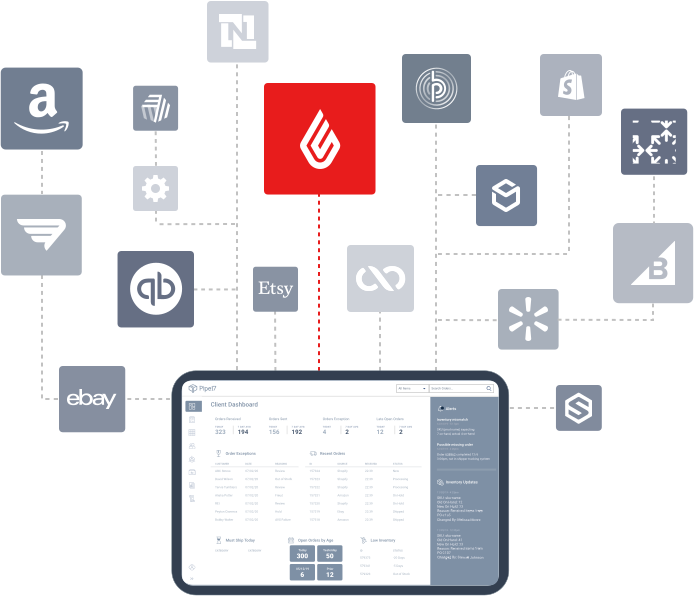
Pipe17 is a modern enterprise OMS with a pre-built, managed connector for Lightspeed Retail that links it to ecommerce platforms like Shopify and BigCommerce, marketplaces, ERPs, and 3PLs from a single Order Operations Platform. The connector covers eight pre-built data flows across orders, products, inventory, fulfillments, receipts, arrivals, and store locations. Multi-store retailers use it to keep brick-and-mortar and digital channels operating against one live inventory pool, so a sale at the register decrements stock everywhere within minutes.
Pipe17 syncs orders, products, inventory, fulfillments, locations, and receipts across Lightspeed Retail and the broader commerce stack. The connector pulls POS orders out of Lightspeed for centralized fulfillment or transfer between stores, and pushes online order fulfillments back into Lightspeed so retail staff see one order history. Inventory updates flow from warehouses and 3PLs like Radial and ShipBob into Lightspeed using incremental updates, while product catalogs sync in both directions to keep SKUs consistent across stores, Shopify, and any marketplace.
A Lightspeed Retail OMS rollout typically runs on a phased timeline rather than a single cutover. With Pipe17, the Lightspeed connector itself activates in days once API credentials and store locations are mapped. From there, brands light up additional channels and fulfillment partners in waves, progressively moving order routing, inventory orchestration, and financial sync onto Pipe17 as a modern enterprise OMS while existing systems keep running. Retailers reduce total cost of ownership by up to 85% versus legacy OMS plus iPaaS stacks, and operations teams reconfigure workflows without code through Pipe17's Order Management UI.
Ship-from-store and BOPIS with Lightspeed Retail require turning each store into a fulfillment node alongside warehouses and 3PLs. Pipe17 StoreOps is a mobile execution app store associates use to pick, prep, and pack ship-from-store orders, or pick and hand off BOPIS orders, running on the devices stores already have. Payment processing and in-store transactions stay in Lightspeed; StoreOps handles only the fulfillment workflow. Tracking pushes back to the originating order source, inventory adjustments sync back into Lightspeed, and stock levels update across every connected selling channel without manual intervention.
Pipe17's inventory management engine maintains a single inventory source of truth across every Lightspeed location, warehouse, and 3PL, with event-based updates that propagate within minutes rather than waiting for batch syncs. When a register sale happens at a Lightspeed store, the decrement flows through Pipe17 to Shopify, BigCommerce, Amazon, and any other connected channel before another shopper can claim the same unit. Retailers using Pipe17 see inventory discrepancies drop by roughly 95% and dead stock drop by 40% because every channel sells against the same live count.
Yes, online orders can be routed to Lightspeed stores by an OMS that ingests every channel and evaluates real-time inventory. Pipe17's order routing engine evaluates real-time inventory, location proximity, SLA thresholds, and business rules to push online orders from Shopify, Amazon, eBay, and TikTok Shop to the optimal Lightspeed store or warehouse. Location groups let operations teams configure wave timing and routing logic for entire store networks at once instead of location by location. Orders execute through StoreOps on store-associate devices, with tracking and inventory adjustments flowing back to the originating channel and to Lightspeed automatically.
Pipe17's modern OMS consolidates Lightspeed POS sales, ecommerce orders, and marketplace transactions into one record set that flows downstream to NetSuite, Acumatica, QuickBooks Online, or Xero for financial reporting. Receipt and arrival data sync back into Lightspeed for accurate stock and cost-of-goods reporting, and channel-level sales attribution stays intact through to the general ledger. Brands using Pipe17 typically cut month-end close time by 75% because manual spreadsheet reconciliation across Lightspeed, online channels, and the ERP is no longer required.
In-store returns of online orders require a closed loop between the Lightspeed register, the originating ecommerce channel, and the ERP. Pipe17 connects all three: when a customer returns an online order at a Lightspeed register or initiates a return through Loop or Happy Returns, Pipe17 routes the RMA back to the originating channel, restocks inventory at the resolving location, and syncs the credit memo and refund into NetSuite, Acumatica, or another connected ERP for general-ledger reconciliation. Receipt and stock adjustments stay accurate across every channel without a separate spreadsheet pass.
Retailers running Lightspeed across ecommerce, marketplaces, and 3PLs need a modern enterprise OMS, not an iPaaS, because order routing, inventory orchestration, holds, splits, and rejections are OMS workloads. Pipe17 combines an enterprise OMS with a managed commerce network in one platform, so retailers do not need to stitch an iPaaS to a legacy OMS to run Lightspeed across digital channels. Legacy OMS platforms were built before omnichannel retail and treat store inventory as a separate ledger. Pipe17 applies a single set of routing and inventory rules across Lightspeed stores, warehouses, and 3PLs, configurable by operations teams rather than developers through the Order Operations Platform.
Real-time inventory sync between Lightspeed Retail and ecommerce requires an event-driven architecture, not batch schedules. Pipe17's Lightspeed connector propagates inventory, order, and fulfillment changes across the stack within minutes on multi-region AWS with 99.99% uptime, scaling to handle millions of orders a day per organization. AI-driven operations include Pippen AI for natural-language order queries and automation code generation, plus the onX-compliant Pipe17 MCP server so agentic selling channels and AI agents can read Lightspeed data, place orders, and trigger workflows through the same connector layer as Shopify or Amazon.
The best order management system for Lightspeed Retail is one purpose-built for omnichannel retail: real-time inventory across every store and digital channel, ship-from-store and BOPIS execution, intelligent order routing, and ERP-grade financial sync. Pipe17 is a modern enterprise OMS that delivers all of it from a single platform, with a pre-built Lightspeed connector and a managed commerce network linking Shopify, Amazon, NetSuite, and hundreds of other systems. Unlike legacy OMS platforms built before omnichannel retail, Pipe17 was designed for event-based inventory and agentic operations from day one.
Managing inventory across multiple Lightspeed Retail locations requires a single inventory source of truth that updates in real time, not nightly batch syncs. Pipe17's inventory management engine maintains a unified, event-based view across every Lightspeed store, warehouse, and 3PL partner like Radial or ShipBob, propagating stock changes within minutes whenever a sale, return, transfer, or receipt happens. Location groups let operations teams set wave rules, SLA thresholds, and routing logic for entire store networks at once. The result is accurate, real-time inventory across every store and every digital channel like Shopify, with no phantom stock, race conditions, or double-counting.
Connecting Lightspeed Retail to NetSuite is straightforward with Pipe17, which provides pre-built connectors for both systems and unifies them inside one Order Operations Platform. Pipe17 pulls POS orders, products, inventory, and store locations from Lightspeed and pushes them into NetSuite as sales orders, item records, inventory adjustments, and locations. Fulfillment, refund, and credit-memo data flows back so NetSuite's general ledger stays accurate without manual entry. The same connector layer extends to Shopify, Amazon, and any other selling channel, so the Lightspeed-to-NetSuite flow becomes part of a broader omnichannel OMS rather than a point integration.