
Amazon announced multichannel selling tools for Seller Central at Accelerate on September 24, 2026, free to sellers in its US store and rolling out over the coming months. The tools put eBay, Shopify, TikTok Shop, and Walmart orders on one Seller Central screen and let Amazon’s Multi-Channel Fulfillment (MCF) ship them. For a seller whose channels are the ones Amazon connects and whose inventory sits in Fulfillment by Amazon (FBA), that is one hub for listings, orders, fulfillment, and profitability.
Midsize and larger brands, and the third-party logistics providers (3PLs) that serve them, run those same channels alongside an enterprise resource planning (ERP) system, a 3PL or their own warehouse, retail trading partners, and wholesale accounts. Their order management runs on a connected order management system (OMS) that treats every channel the same way, Amazon’s hub included. Pipe17 is that connected OMS, and Seller Central and MCF are two of the integrations it maintains.
Amazon is a Pipe17 partner, and so are Shopify, Walmart, and TikTok Shop, so this post is a read from the operations side on what Amazon’s new hub does well and where the rest of a brand’s order operations still live.
What did Amazon add to Seller Central?
Amazon added a multichannel settings page to Seller Central, at no additional cost, for sellers in its US store, rolling out gradually. Amazon says a seller chooses which channels to connect and what data to share, and that the data is not used to inform its retail business decisions.
Four things are available now.
- Channel connections. eBay, Shopify, TikTok Shop, and Walmart accounts connected from the multichannel settings page.
- Listings. Off-Amazon listings imported and linked to the matching Amazon products.
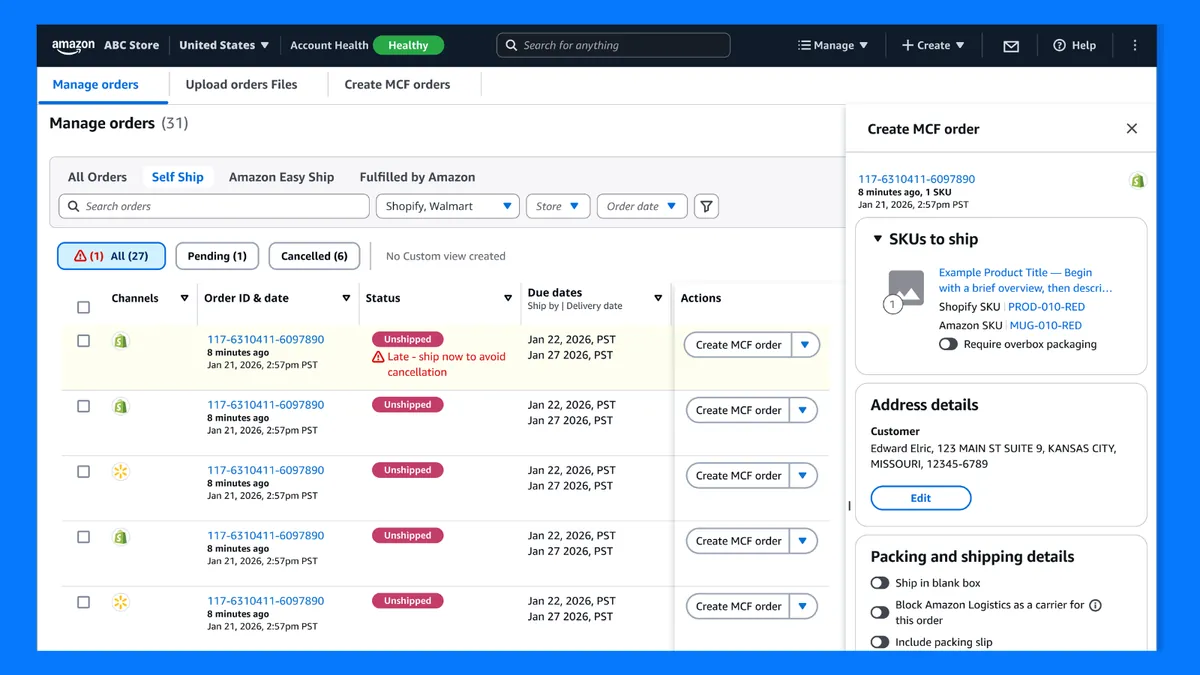
- Manage Orders. Unshipped orders from each of those channels in one view, with order details, customer information, and fulfillment options.
- MCF fulfillment. Orders from those channels shipped from FBA inventory through MCF, with tracking sent back to Shopify in Amazon’s example.
Amazon says four more features are coming to the hub.
- Edit products once. A product description enhanced on the Manage Products page and reformatted for each linked listing.
- AI listing content. Channel-ready copy for each listing, generated by Amazon’s AI.
- Cross-channel profitability. A real-time view of what each product earns, pulling ad spend, traffic, and sales from every connected channel.
- More channels. Amazon says more are on the way and has not named them.
Why Seller Central’s multichannel hub is good news for sellers
Seller Central’s multichannel hub spares a seller a separate login, dashboard, and workflow for each channel, and it gives sellers already shipping through MCF one place to ship from. Amazon says more than 95% of independent sellers in its store sell across multiple channels, and that independent sellers drive more than 60% of its sales. The hub meets most of its sellers where they already are.
Amazon’s own example is Pamela Lee, director of digital operations at Elizabeth Mott, whose reporting team of three can now “see it all in one view.” David Forsythe, Amazon’s VP of North America seller business, put the intent plainly to PYMNTS: “We really believe that when sellers succeed across their entire business, they’re going to succeed on Amazon as well.”
The bigger point for anyone who runs operations is the principle Amazon has now built into Seller Central. Amazon has made one place for every channel’s orders the default expectation for its sellers. That is the case for an OMS, made by Amazon.
How do Amazon’s tools compare with Walmart Multichannel Solutions and Shopify Marketplace Connect?
Amazon’s multichannel selling tools, Walmart Multichannel Solutions, and Shopify Marketplace Connect each centralize other channels’ orders around their own platform.
| Amazon multichannel selling tools | Walmart Multichannel Solutions | Shopify Marketplace Connect | |
|---|---|---|---|
| Where you work | Amazon Seller Central | Walmart Seller Center | Shopify admin |
| Channels covered | eBay, Shopify, TikTok Shop, Walmart, with more coming | Amazon, eBay, Shein, Temu, TikTok Shop, and more | Amazon, Walmart, eBay, Target Plus |
| Fulfillment | Optional, through MCF from FBA inventory | Required, through Walmart Fulfillment Services (WFS) inventory | Managed with your other Shopify orders |
| Inventory pool | FBA stock for MCF orders | One WFS pool across channels | Shopify inventory synced to each marketplace |
| Listings | Import, link, and edit once (coming) | Fulfillment program; listings stay in each channel | Synced from the Shopify catalog |
Each hub is good at its job because it is built around its owner’s network, and that network is also where each hub’s scope ends.
What does a connected OMS add for a brand selling on Amazon, Walmart, TikTok Shop, and Shopify?
Amazon’s multichannel selling tools cover one seller account. In Amazon’s description, that means the listings, orders, fulfillment, and profitability of the channels a seller connects, with MCF as the fulfillment service and FBA as the inventory it ships from.
Orders at a midsize or larger brand run through more systems than one Amazon seller account. Each order posts to an ERP. Fulfillment comes from a 3PL, or from your own warehouse on a warehouse management system (WMS), as well as from FBA. Retail trading partners send purchase orders over electronic data interchange (EDI), and business-to-business (B2B) wholesale accounts send orders of their own. All of it draws on inventory held in every one of those places.
A connected OMS adds multichannel order management across all of those order sources and fulfillment locations, with one order record, one live inventory pool, and managed integrations to each system. Pipe17 is a connected OMS. It pulls orders from marketplaces, the storefront, point of sale systems, AI agents, the ERP, and EDI retail partners, decides where each one ships from, keeps a single inventory source of truth, and posts the results back to each channel and to the financial ledger.
- Integrations Pipe17 builds and maintains. Pipe17’s managed connectivity network covers ecommerce platforms, marketplaces, wholesale marketplaces, retail EDI programs, 3PLs and fourth-party logistics providers (4PLs), WMS, ERPs, financial systems, point of sale, returns platforms, listing tools, data lakes, and shipping platforms and carriers. Pipe17 keeps each integration current as the channel APIs change, Seller Central and MCF included. A change on Amazon’s side is Pipe17’s work rather than your team’s.
- All order sources in one record. Amazon Seller Central orders arrive alongside Walmart Marketplace, TikTok Shop, eBay, and Shopify orders, ERP orders, and purchase orders from retail EDI programs, so the queue your team works is the whole business.
- One routing decision across MCF, 3PLs, warehouses, and stores. Pipe17 picks the fulfillment location for each order against live inventory through order routing, and Amazon MCF is one of the destinations it can choose, next to a 3PL, your own WMS, or a store.
- A single inventory source of truth. Pipe17 holds one live inventory pool across FBA, 3PLs, warehouses, and stores through inventory visibility, and Inventory Buffers hold back units per channel when stock runs low. Regional stock that never syncs is where multi-location overselling starts.
- Settlements posted to the ERP. Amazon, Shopify, and TikTok Shop settlement and payout reports post to NetSuite or another ERP for reconciliation, so finance closes from one ledger, on time and accurately.
- Returns from Shopify, TikTok Shop, and Walmart. A return that starts in any of the three lands as a return merchandise authorization (RMA), is received against what was authorized at your warehouse, 3PL, or store, restocks sellable units into live availability, and carries the refund or exchange to the ERP. That is returns management.
- Exceptions caught before the customer finds them. Through exception resolution, Pipe17 watches orders, shipments, inventory, and integrations across all channels, routes each exception to the team that can act on it, and resolves most of them automatically.
Should you use Amazon’s multichannel selling tools, a connected OMS, or both?
The deciding questions are where your inventory sits and what else your orders touch, not how large a share of your revenue Amazon carries. Amazon’s multichannel selling tools cover the seller account. A connected OMS covers the business, with Amazon’s hub, Walmart’s, and Shopify’s treated as channels it serves rather than the place it lives.
- Amazon’s tools alone. A seller whose channels are the ones Amazon connects, whose inventory all sits in FBA, and who has no ERP to post to has what it needs in Seller Central.
- A connected OMS. Midsize and larger brands are channel agnostic by necessity. An ERP, inventory outside FBA, a 3PL or WMS, a retail EDI program, or a wholesale account changes the job. So does reconciling settlements across Amazon, Shopify, and TikTok Shop payouts. At that point one order record and one inventory pool become the control point for the business.
- Both, side by side. Pipe17 pulls Amazon orders from Seller Central. It routes Shopify, Walmart, and TikTok Shop orders to MCF or to another fulfillment location based on your routing rules, and writes the shipments back. What a seller sees in Seller Central and what operations sees in Pipe17 is the same order. That is the pattern for connecting Amazon and marketplace orders to your order operations.
Amazon has made one screen for every channel’s orders the expectation. Pipe17 makes it true for all of your order sources and every location you ship from, Seller Central and MCF included.
Frequently asked questions
What do Amazon’s multichannel selling tools cover, and what does a connected OMS add?
Amazon’s multichannel selling tools cover listings, orders, MCF fulfillment, and profitability for the channels a seller connects to Seller Central. A connected OMS such as Pipe17 covers the rest of the business. It connects those channels to the ERP, retail EDI partners, and wholesale accounts, holds every order in one record, routes each order across MCF, 3PLs, warehouses, and stores for fulfillment, and keeps a single inventory source of truth.
Which fulfillment options work with Amazon’s multichannel selling tools?
Multi-Channel Fulfillment from FBA inventory is the fulfillment option built into Amazon’s multichannel selling tools. Orders that ship from a non-Amazon 3PL, your own warehouse, or a store are routed there by a connected OMS like Pipe17, which sends the shipment confirmation back to the originating order source.
How do you keep inventory in sync across Amazon, Walmart, TikTok Shop, and Shopify when orders arrive in Seller Central?
With all inventory in FBA and shipping through MCF, Amazon’s tools fill every connected channel’s orders from that one pool. Inventory held beyond FBA, in a 3PL, a warehouse, or a store, needs one live count synced to all channels, or each sells against a siloed count and oversells or undersells. That cross-channel count and sync is the job of a connected OMS like Pipe17.
How are returns handled for Shopify, Walmart, or TikTok Shop orders that ship through Amazon’s multichannel selling tools?
For an order MCF ships, the seller creates the return in Seller Central or by API, and Amazon issues the RMA and a return mailing label to an Amazon fulfillment center, per Amazon’s MCF guide. The refund, exchange, restock, and ERP posting are returns management, which a connected OMS like Pipe17 runs for returns that start in Shopify, TikTok Shop, or Walmart.
Can Pipe17 run alongside Amazon’s multichannel selling tools?
Yes, Pipe17 runs alongside Amazon’s multichannel selling tools, because Pipe17 connects to the same Seller Central account through Amazon’s Selling Partner API and routes orders to the same MCF network. Sellers can use Manage Orders in Seller Central while Pipe17 carries the orders into the ERP, 3PL, and WMS, keeps one live inventory pool, and writes tracking back to each channel.