Can your team write its own ecommerce integrations with an AI coding agent? More people are asking me that question this year, and the answer is yes, for the code. An agent can read a marketplace’s API documentation and produce a working integration in an afternoon.
In McKinsey’s State of AI 2026 survey, nearly one-third of respondents said their organizations had decided against buying a software product or feature because they were able to build it in-house with agentic coding tools. That share will climb for well-understood software like a CRM, where an agent has years of public examples to learn from. Integrations are harder to hand to an agent. There is little public material on how to connect a Mirakl marketplace to a homegrown warehouse management system (WMS).
In The SaaS Apocalypse Is Real I argued that one question separates the software AI can cheaply replace from the software it can’t: what happens when it’s wrong?
A stale dashboard is one answer. A double shipment is another. An integration with a selling channel or fulfillment partner falls on the double-shipment side. It carries orders, inventory, and a delivery promise between systems that keep changing, for as long as you sell. AI can write that integration.
Running it, which means securing, hosting, monitoring, and updating the code every time a system on either end changes, is the expensive part. A mistake in that code costs real money in canceled orders, late shipments, and lost sales. That’s why every change needs thorough testing before it ships.
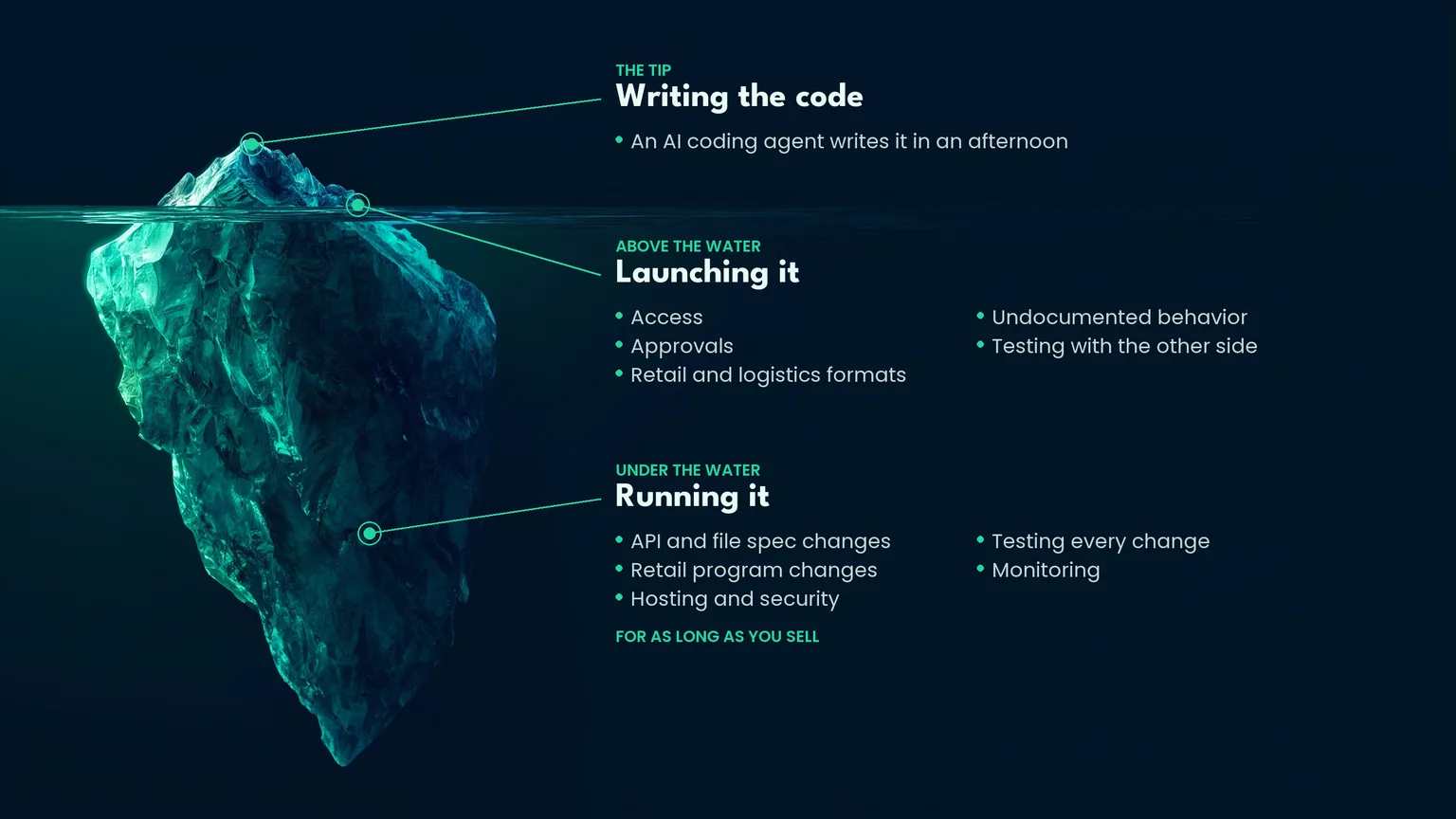
Writing code is the tip of the iceberg
AI has made writing code fast and cheap, and Pipe17’s engineers use coding agents for exactly that work.
But writing code is just a fraction of what it takes to build an ecommerce integration. Every integration has three parts: writing it, launching it, and running it for as long as you sell.
Launching ecommerce integrations
Going live with a real storefront, marketplace, retailer, or third-party logistics (3PL) provider requires:
- Access. A working sandbox and credentials from the other side. Some vendors only allow a build when a live customer is going into production with it.
- Approvals. Marketplace developer programs, legal agreements, and security reviews. Amazon, for one, puts every Selling Partner API developer through a security review and requires a formal data security assessment for any application that handles customer data.
- Retail and logistics formats. Electronic data interchange (EDI) purchase orders, advance ship notices (ASN), and invoices. Flat files on FTP servers. Interfaces built decades ago, where the partner’s IT team has to set up each new connection by hand.
- Undocumented behavior. Often the hardest part. Logistics systems don’t always work the way their documentation says, and many have no documentation at all. A 3PL’s homegrown WMS, or an enterprise resource planning (ERP) system set up years ago by a team that has since moved on, may follow rules nobody wrote down. The agent still has to ask a person how that system handles a split shipment or a backorder.
- Testing with the other side. End-to-end order tests against real scenarios, run on the 3PL’s or retailer’s schedule, not yours.
None of that is writing code, and an agent can’t prompt its way past a retailer’s onboarding queue.
Running ecommerce integrations
Under the water sits the third part, running the integration once it’s live. It needs care every day the business sells, which makes a commerce integration a pet, not a project. That care includes:
- API and file spec changes. Marketplaces retire API versions. 3PLs change file specs. ERPs get upgraded.
- Retail program changes. Retailers revise their EDI requirements, with a deadline and a chargeback behind them.
- Hosting and security. The code needs somewhere to run, and security fixes keep coming as attackers pick up new tools.
- Testing every change. Each one has to be caught, tested, and shipped before it breaks an order.
- Monitoring. Someone has to watch every flow and the systems at both ends of it. A system at either end can go down with no change on your side, and the first sign is usually an order that didn’t move.
AI shrinks the tip. The testing and upkeep under the water never end. They grow with every connection.
A brand with 6 sales channels, 3 fulfillment partners, and an ERP runs 10 systems. Connecting each one to every other would take 45 integrations. AI can write those connections and rebuild the old point-to-point web quickly. It doesn’t make the upkeep any lighter.
And what happens if the person who vibe coded your integrations leaves? Who looks after your integration pets then?
What happens when a commerce integration breaks?
When an order or inventory flow between systems is late or wrong, the business pays for it long before IT hears about it. Inventory is where the damage shows up first, in both directions.
| Flow | What goes wrong | What it costs the business |
|---|---|---|
| Inventory sync | A marketplace sale doesn’t reach the storefront in time | An oversell, a canceled order, and a customer less likely to buy again |
| Inventory across locations | Stock held at one warehouse or 3PL never rolls up, so a selling channel shows zero available | An undersell: the product reads as out of stock, and a shopper or an AI shopping agent checking availability moves on to a competitor |
| Order handoff to the 3PL | The order arrives late, with a bad address, or with a mismatched SKU | A missed ship-by date, a broken delivery promise, and expedited shipping paid out of margin |
| Tracking sync back to the order source | The tracking number never posts | “Where is my order” tickets, plus late-shipment metrics that put a marketplace seller account at risk |
Now add peak season. Order volume multiplies, and an hour of downtime can erode your P&L. That is the bill for an integration flow nobody was maintaining, and it lands on revenue, not on the engineering budget.
The decision to build vs buy integrations comes down to two questions:
- How many connections are you taking on?
- What does each connection carry?
When should you build your own integrations with AI?
Build your own ecommerce integrations with AI when you need one or two connections to modern platforms with well-documented APIs, and a late or failed sync wouldn’t cost you a sale or upset a customer. Sending storefront orders to a data warehouse for reporting is a good example. If that integration breaks, a dashboard goes stale and someone fixes it before the next board meeting. No customer notices and no sale is lost. Write it, ship it, and move on.
The math changes when connections multiply and when an integration flow carries orders, inventory, fulfillments, or a delivery promise. These integrations belong in an order management system (OMS), and there are two ways to handle those connections:
- Build and maintain each integration into the OMS yourself, likely with help from an iPaaS
- Run them on a connected OMS, like Pipe17, which operates the whole connectivity network for every customer and leaves your team much less to do
| Build it with AI | Run it on a connected OMS | |
|---|---|---|
| Number of connections | One or two | Many channels, systems of record, and 3PLs |
| What the flow carries | Reporting or internal data | Orders, inventory, tracking, and retail documents a customer or retailer depends on |
| Partner approvals and security reviews | Yours to win and keep | Held by the operator for every connector on its network |
| API changes | You find out when orders stop | The operator updates the connector as the vendor changes |
| When the builder leaves | The knowledge goes with the builder | The operator’s team still owns the connector |
| Best use of AI | Building the integration | Building what’s unique to your business |
On a connected OMS, each connection is a managed connector. The operator keeps it current as the marketplace or 3PL changes, and your team only configures it.
AI still belongs in your stack. Point it at what’s unique to your business, such as a homegrown warehouse app no vendor has a managed connector for, or a rule for a key account.
On Pipe17 that work runs through our Unified API. The Commerce 360 Data Model™ means your team, or an AI agent, writes that code once against Pipe17 instead of once per vendor. And Pippen, Pipe17’s AI order operations agent, writes automation rules from a plain-language description on your behalf. Your own agents work with orders and inventory through the Pipe17 Model Context Protocol (MCP) Server instead of through a connection you maintain.
The combination of a modern platform, pre-built flows and connections, and a commerce-aware agent gives you the benefits of building connections yourself. It’s super quick, intuitive, and zero to maintain, with the flexibility and customizability that AI development promises.
Pipe17 is the connected OMS that runs the network
Pipe17 runs the network your orders and inventory move on, and that job doesn’t shrink when code gets faster to write. We hold the marketplace, partner, and developer relationships, maintain every connector as APIs change, and continuously monitor order and inventory flows. As an OMS, Pipe17 keeps one live inventory pool across your channels, and routes every order to the right warehouse, 3PL, or store for fulfillment. You get connectivity and order management in one platform, with no second vendor between your integrations, orders, and inventory.
A network needs an operator. Kelly Goetsch, our president, put it this way in A New Chapter for Pipe17: “we as a network operator stay in front of all those changes.” He calls Pipe17 the Plaid of Commerce. The Pipe17 Network does for selling channels (DTC, B2B, retail, and agentic), ERPs, and fulfillment locations what Plaid does for banks.
When a prospect tells me their team can write an integration with Claude, I agree with them. Then I ask who will be running it next peak season, and the one after that.
AI is a great builder. Somebody still has to run the network.
Frequently asked questions
Can AI build ecommerce integrations?
AI coding agents can write the code for an ecommerce integration, and they do it well. The code is only a fraction of the job, though. Before launch, you still need access, partner approvals, retail formats like EDI, and answers about systems that don’t work the way their documentation says. After launch, someone has to secure, host, monitor, and update the integration every time an API or file spec changes. On a connected OMS like Pipe17, the operator handles that upkeep for you.
Should you build or buy integrations now that AI writes code?
Build ecommerce integrations with AI when you need one or two connections to modern platforms with well-documented APIs and a failed sync wouldn’t cost real money. Run them on a connected OMS like Pipe17 when connections multiply or a flow carries orders, inventory, fulfillments, or a delivery promise. Writing the code was never the cost that lasts. Keeping dozens of connections running through every API change is.
Can I build custom integrations on Pipe17 with AI coding tools?
Yes, custom integrations on Pipe17 are built on the Unified API and the Commerce 360 Data Model™, and an AI coding agent writes them the way a developer does. Connect an in-house system once and it exchanges orders, inventory, and fulfillments with the channels and fulfillment partners on your Pipe17 account. Your agents can also work with orders and inventory through the Pipe17 MCP Server.