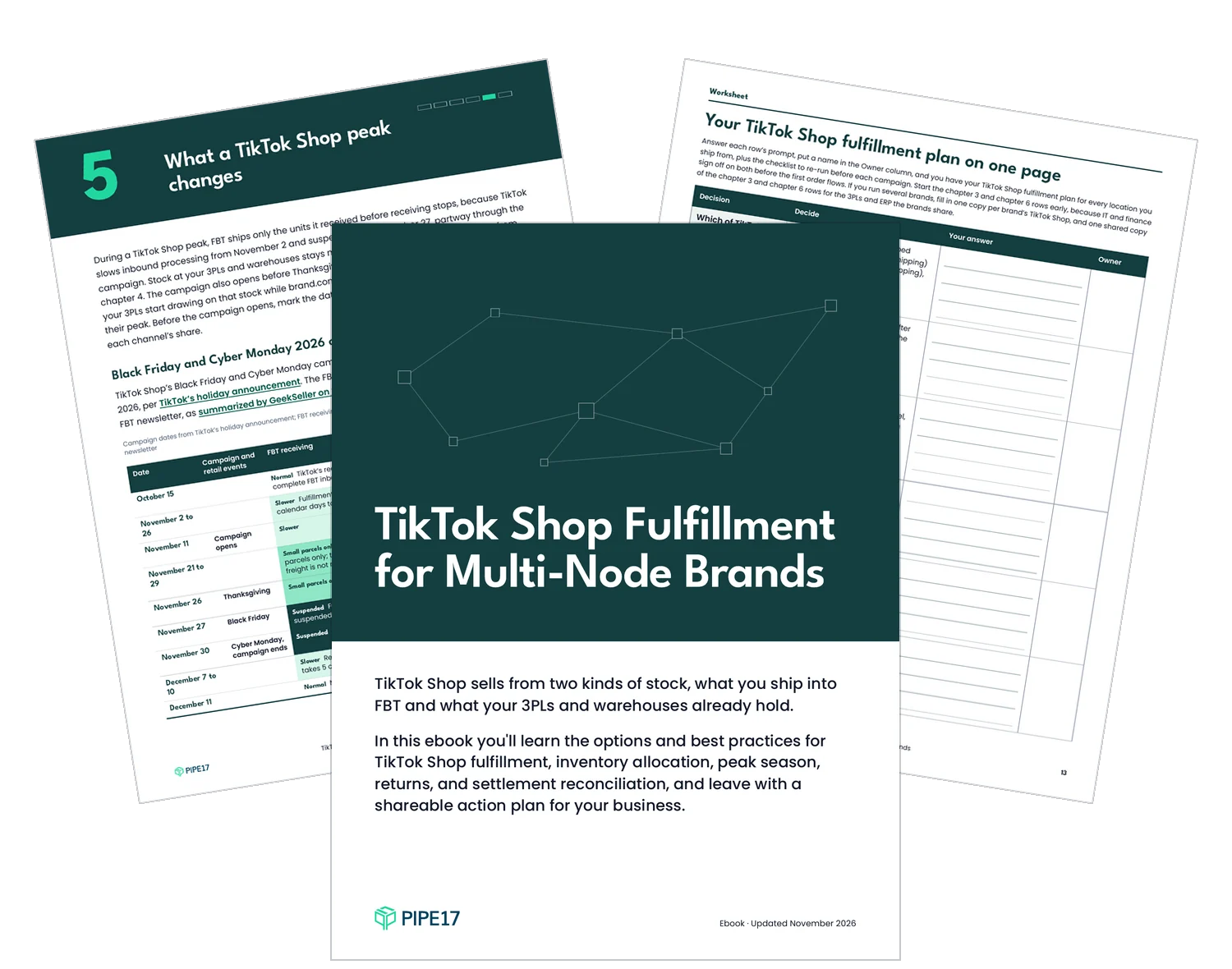
TikTok Shop sells from two kinds of stock, what you ship into FBT and what your 3PLs and warehouses already hold. In this ebook you'll learn the options and best practices for TikTok Shop fulfillment, inventory allocation, peak season, returns, and settlement reconciliation, and leave with a shareable action plan for your business.
For brands that sell on several channels, fulfill through more than one provider, and keep the books in an ERP.
In this ebook
Updated
TikTok Shop gives a seller 3 fulfillment options, and they differ in who holds the stock and who buys the shipping label.
TikTok Shipping and Seller Shipping orders both leave from your stock, and this ebook calls them seller-shipped. The 3 options are not exclusive, and your first decision is which to run for which stock-keeping units (SKUs), brand by brand if you run several.
TikTok names the 3 in its US Logistics Services Overview, updated . Per the same page, a seller can run FBT and its own warehouse together. When a SKU sits in both, TikTok fills the order from FBT first and from your warehouse once FBT is empty.
TikTok stores, picks, packs, and ships FBT inventory from its fulfillment centers. You decide which SKUs go into FBT and how many, and you send them in; chapter 2 walks through that transfer. A unit inside FBT ships only TikTok Shop orders unless your account runs TikTok’s Multiple Channel Fulfillment service, which the FAQ covers. In return, per TikTok’s FBT page, eligible FBT products carry TikTok’s 3-Day Delivery badge, and logistics issues on FBT orders are excluded from your seller performance metrics.
With TikTok Shipping, TikTok supplies the shipping label and your warehouse or 3PL picks and packs the order and hands it to the carrier on that label. Under Collection by TikTok, TikTok collects the parcels from your location instead of you handing them to the carrier, in the regions where it runs pickups.
Because the label is TikTok’s, the location that ships the order prints it, in Seller Center or through its warehouse system’s own TikTok Shop integration. Pipe17 pulls the order in as fulfilled, for your ledger and your ERP.
Seller Shipping keeps the pick, the pack, and the label with you, on the carriers and service levels you choose. It lets a 3PL that already ships your other channels’ orders ship TikTok Shop orders on the carrier accounts it uses for them, yours or its own. Pipe17 routes Seller Shipping orders across your locations by your rules. Amazon’s and Walmart’s fulfillment networks use Seller Shipping too when they fulfill a TikTok Shop order for you, per GeekSeller’s guide to TikTok Shop fulfillment options, published .
| Option | Fulfilled by TikTok | TikTok Shipping | Seller Shipping |
|---|---|---|---|
| Storage | TikTok’s fulfillment centers | Your warehouses or 3PLs | Your warehouses or 3PLs |
| Pick and pack | TikTok | Your warehouse or 3PL | Your warehouse or 3PL |
| Shipping label | TikTok | TikTok | You or your 3PLs |
| Which orders the stock can ship | TikTok Shop orders, and other channels’ orders through TikTok’s multichannel service | Any channel’s orders | Any channel’s orders |
| What you decide | Which SKUs go in, how many, and when to replenish | Which location prints TikTok’s labels and ships | Which location ships each order, by your routing rules, on which carrier and service level |
Delivery speed
Shoppers judge a TikTok Shop order by when it arrives, and TikTok scores sellers on delivery too. TikTok’s holiday announcement puts a 3-Day Delivery badge on eligible products. Orders your 3PLs ship sit beside those listings and are scored against the seller performance thresholds listed on the TikTok Shop integration page.
FBT inventory is physical stock in TikTok’s fulfillment centers, and in Pipe17 it shows as one more location beside your 3PLs and warehouses. Its count starts at what you ship in and falls as TikTok ships orders from it. Decide what goes in early, because from November 27 TikTok’s fulfillment centers receive nothing until December 7.
FBT replenishment runs in 4 steps, as a transfer order from one of your warehouses or 3PLs to the FBT location.
If TikTok cancels the inbound, Pipe17 cancels the transfer order. If TikTok takes in fewer units than you sent, Pipe17 closes the transfer at the received quantity, as the TikTok FBT Inbound connector documents.
When FBT ships a TikTok Shop order, Pipe17 still pulls that order into your ledger through the TikTok Shop connector, and chapter 6 follows it into the ERP.
If you already set what FBA or Walmart Fulfillment Services (WFS) holds, FBT is the same call for a third program. All 3 hold your stock in the marketplace’s fulfillment centers, and each ships other channels’ orders through a multichannel service of its own.
| Program | Fulfilled by TikTok (FBT) | FBA with Multi-Channel Fulfillment (MCF) | WFS with Multichannel Solutions (MCS) |
|---|---|---|---|
| Who holds the stock | TikTok’s fulfillment centers | Amazon’s fulfillment centers | Walmart’s fulfillment centers |
| Orders it ships | TikTok Shop orders, plus other channels’ orders through TikTok’s multichannel service | Amazon orders through FBA, and other channels’ orders through MCF, TikTok Shop included | Walmart orders through WFS, and orders from Amazon, eBay, Shopify, Temu, TikTok Shop, and your own site through MCS |
| In your ledger on Pipe17 | A location replenished by transfer order | A location replenished by transfer order, and a fulfillment location a TikTok Shop order can route to | WFS inventory, held as its own virtual location |
Yes, the 3PLs, warehouses, stores, and dropship partners that ship your brand.com, Amazon, retail, and wholesale orders ship TikTok Shop orders from the same shelves. A sale on any channel adjusts availability on the rest, and each location keeps working the way it always has. Your decision is which locations serve TikTok Shop. If your routing rules already run in Pipe17, that means adding one channel to them. If a legacy order management system (OMS) routes your other channels, TikTok Shop moves first. Pipe17 runs it, the legacy OMS keeps its channels, and the rest move one at a time. Four things follow on the counts Pipe17 keeps.
A TikTok Shop order under Seller Shipping takes the same 5-step path as any other channel’s order.
Each location then works from one inventory feed, not one per channel. Chapter 4 sets how many of those units each channel sees.
Inventory allocation by channel means deciding how many of your available units each channel may sell. When a SKU runs low, you choose which channels stop offering it and which keep selling it to the last unit. The units stay where they are. What changes is the number each channel is allowed to see. TikTok Shop inventory, the number Pipe17 sends the listing from your 3PLs and warehouses, is whatever share of the count you allow it. You set that share per SKU and per channel, and it is the line on your plan you will change most.
A business user sets these controls, with no engineering ticket, for the stock at your 3PLs and warehouses.
Set each SKU’s buffer, channel shares, and location floors before the campaign opens, then change them on the TikTok dates in chapter 5.
During a TikTok Shop peak, FBT ships only the units it received before receiving stops, because TikTok slows inbound processing from November 2 and suspends it on November 27, partway through the campaign. Stock at your 3PLs and warehouses stays movable, under the allocation controls from chapter 4. The campaign also opens before Thanksgiving weekend, and TikTok Shop orders from your 3PLs start drawing on that stock while brand.com, Amazon, and retail are still building toward their peak. Before the campaign opens, mark the dates on which you re-check what FBT holds and each channel’s share.
TikTok Shop’s Black Friday and Cyber Monday campaign runs from to , per TikTok’s holiday announcement. The FBT receiving dates come from TikTok’s September FBT newsletter, as summarized by GeekSeller on .
| Date | Campaign and retail events | FBT receiving | What it means for your stock |
|---|---|---|---|
| NormalTikTok’s recommended date to complete FBT inbound | Later inbound still lands; from November 2 it is processed more slowly | ||
| to | SlowerFulfillment centers take 5 calendar days to process inbound | Late top-ups land slowly; count them as inbound, not available | |
| Campaign opens | Slower | TikTok Shop orders start drawing on your 3PL counts, 16 days before Black Friday | |
| to | Small parcels onlyFBT hubs accept small parcels only; trucking and floor-loaded freight is not received | Freight top-ups must reach FBT before November 21; after that, send small parcels only | |
| Thanksgiving | Small parcels only | Brand.com and retail peak weekend begins | |
| Black Friday | SuspendedFulfillment-center receiving suspended through December 6 | FBT’s allocation is fixed; only stock at your 3PLs and warehouses can still move | |
| Cyber Monday, campaign ends | Suspended | Last campaign day for orders shipped from FBT and from your 3PLs | |
| to | SlowerReceiving resumes; processing takes 5 calendar days | Post-campaign replenishment lands, on slower processing | |
| Normal |
Re-check the plan on 3 of those dates.
In a portfolio, run these 3 re-checks for each brand’s TikTok Shop, since each storefront connection carries its own buffers. Start with the 3PLs that ship for more than one brand, because every brand in the campaign starts drawing on those docks the same day.
Four posts cover the rest of the peak, from cutoffs and overflow to carrier deadlines and returns.
A connected OMS running TikTok Shop beside an ERP keeps 4 loops closed around every order: exceptions, settlement, returns, and the ERP record. Each one fails quietly when TikTok Shop runs as a separate feed. Name who closes each one in your stack, whether Pipe17, the ERP, or your returns platform.
Your plan
Answer each row’s prompt, put a name in the Owner column, and you have your TikTok Shop fulfillment plan for every location you ship from, plus the checklist to re-run before each campaign. Start the chapter 3 and chapter 6 rows early, because IT and finance sign off on both before the first order flows. If you run several brands, fill in one copy per brand’s TikTok Shop, and one shared copy of the chapter 3 and chapter 6 rows for the 3PLs and ERP the brands share.
| Decision | Decide | Your answer | Owner |
|---|---|---|---|
| Which of TikTok’s fulfillment options you runChapter 1 | FBT or not, and for seller-shipped orders, TikTok’s label (TikTok Shipping) or your routing rules (Seller Shipping), SKU by SKU | ||
| What FBT holdsChapter 2 | The SKUs and units in FBT, sized after the TikTok Shop buffer you set in the chapter 4 row, the date last replenished, and whether TikTok’s multichannel service is in use | ||
| Which 3PLs and warehouses ship the orders FBT does notChapter 3 | Which 3PLs, warehouses, stores, and dropship partners serve each channel, the routing rule for each brand, which locations ship for more than one brand, and which OMS routes TikTok Shop while a legacy OMS still runs other channels | ||
| What each channel may sellChapter 4 | The TikTok Shop buffer per SKU, each channel’s share of available units, and safety stock per location | ||
| When to re-check FBT stock and channel sharesChapter 5 | November 11 (campaign opens, buffers in place), November 21 (FBT takes small parcels only), November 27 (fulfillment-center receiving suspends, re-check FBT on hand and reset buffers), per TikTok’s 2026 calendar | ||
| Who closes each loop behind every orderChapter 6 | Who gets the exception when a sync stalls, how settlement posts to the ERP and to which brand’s subsidiary, and who approves whether orders reach the ERP one by one or, on NetSuite, as a period batch |
Pipe17 is the connected order management system (OMS) that adds TikTok Shop as one more channel on the same live inventory ledger as Shopify, Amazon, retail, agentic, and wholesale.
Listings come from the catalog you already keep in your Shopify store, ERP, or PIM. You set how many units TikTok Shop may sell, and Pipe17 restocks Fulfilled by TikTok (FBT) with transfer orders.
Pipe17 routes each Seller Shipping order (one shipped on your own label) to the optimal 3PL, warehouse, or store based on your order routing configuration. With Pipe17 posting orders, returns, and settlements to your ERP, finance reconciles TikTok Shop in the same books as every other channel.
Orders
Pipe17 pulls TikTok Shop orders, holds Seller Shipping orders through the cancellation window when you choose, and routes each one to the location holding the stock, by your order management rules.
Inventory
One live count per location, FBT included, with the buffers and safety stock that set each channel’s share, kept current by Pipe17.
Products
Pipe17 lists and updates your products on TikTok Shop from the Shopify store, ERP, or PIM that holds your catalog. It pulls the listings TikTok Shop already carries and maps each channel’s SKUs to one product, with no second catalog to maintain.
Connectors
The TikTok Shop connector carries orders, fulfillments, inventory, products, returns, and settlements, and the TikTok FBT Inbound connector runs replenishment into FBT as transfer orders with receipts to your ERP. The Pipe17 MCP Server gives your AI agents the same ledger through the Model Context Protocol, for stock checks and order questions.
Setup
Your ops team sets routing, holds, buffers, safety stock, and exception recipients in Pipe17, in no-code workflows or in plain language to Pippen.

A multi-brand portfolio whose TikTok Shop orders follow the same Pipe17 routing and inventory logic as its direct-to-consumer orders.

Connected 5 TikTok storefronts as separate instances through Pipe17, beside 2 Amazon stores, 3 Shopify storefronts, NetSuite, and its 3PLs.

Live on TikTok Shop in under 6 weeks, with the 3PL workflow unchanged.
Short answers to what brands ask before TikTok Shop joins a fulfillment network that already ships several channels.
TikTok Shop should get the FBT stock you ship in before receiving closes on November 27, plus the share of your 3PL and warehouse stock left once a TikTok Shop buffer holds back the units brand.com and retail need for Thanksgiving weekend. Pipe17 applies inventory buffers to stock at your 3PLs and warehouses, and FBT is allocated by what you ship in. TikTok Shop’s campaign opens , 16 days before Black Friday, and the buffer has to be in place before that date.
Order holds, per-channel buffers, and re-routing keep a shared 3PL from being overcommitted during a peak, and Pipe17 applies all three to every channel’s orders in one order management queue. A hold keeps a TikTok Shop order out of the pick queue through its cancellation window, and a buffer stops a channel selling past the units your other channels need. When a 3PL rejects an order it cannot fill, Pipe17 routes it again to the next location your rules name and skips the one that turned it down.
Inventory in Fulfilled by TikTok is physical stock in TikTok’s fulfillment centers that ships TikTok Shop orders, while inventory at your 3PL ships every channel’s orders, including seller-shipped TikTok Shop orders. You replenish FBT stock with inbound shipments raised in Seller Center, and it reaches other channels only through TikTok’s multichannel service, and 3PL stock moves wherever you send it. The TikTok FBT Inbound connector records each replenishment as a transfer order with a receipt to your ERP, and Pipe17 shows FBT and each 3PL as separate locations in one ledger.
Pipe17 is a connected OMS that runs TikTok Shop alongside NetSuite or Acumatica, treating TikTok Shop as one channel on the same ledger as Shopify, Amazon, and retail while the ERP stays the system of record. Orders, inventory, fulfillments, refunds, and payout data flow between TikTok Shop and NetSuite or Acumatica through connectors Pipe17 maintains, and every TikTok Shop order reaches the ERP as its own record, or on NetSuite inside one aggregated order per period. For SAP or Microsoft Dynamics, your team or systems integrator builds the ERP integration on Pipe17’s Unified API, and TikTok Shop runs on Pipe17 the same way.
A 3PL that ships ecommerce orders for brands can ship TikTok Shop orders, because to the warehouse a TikTok Shop order is an ordinary order to pick, pack, and ship. A 3PL connected through Pipe17’s pre-configured connectors receives Seller Shipping orders on the feed that carries its Shopify and Amazon orders, and 3PLs that run their client operations on Pipe17 extend that feed to every brand they serve. What separates 3PLs for a multi-node brand is whether TikTok Shop orders arrive on that one feed, with tracking written back to TikTok Shop on time.
Fulfilled by TikTok ships other channels’ orders through Multiple Channel Fulfillment, TikTok’s multichannel service, which fills non-TikTok Shop orders from FBT inventory once your FBT Logistics Manager activates it for your account. Orders reach it by manual import in the Merchant Portal or by a push from an ERP, per TikTok’s FBT Seller Academy course of . Amazon’s Multi-Channel Fulfillment ships any channel’s orders out of FBA stock, and Amazon’s MCF page points TikTok Shop sellers to supported integration apps. PPC Land reports that TikTok Shop Academy lists 9, Pipe17 included. Walmart’s Multichannel Solutions does the same out of WFS inventory, TikTok Shop orders included. Brands on Pipe17 see each program as a location in their ledger and route Seller Shipping orders from TikTok Shop to Amazon MCF or a 3PL by rule.
A portfolio can connect a TikTok Shop storefront for each brand to Pipe17, each as its own instance, beside the rest of its channels. At e.l.f. Beauty, adding TikTok Shop meant configuring a new connection inside the infrastructure its brands already share, not a separate integration project. Each brand keeps its own automations and routing rules on that infrastructure, as at The Estée Lauder Companies, where every launch after the first inherits the patterns of the one before it. One brand can run several storefronts too, and SACHEU runs 5 TikTok storefronts through Pipe17.