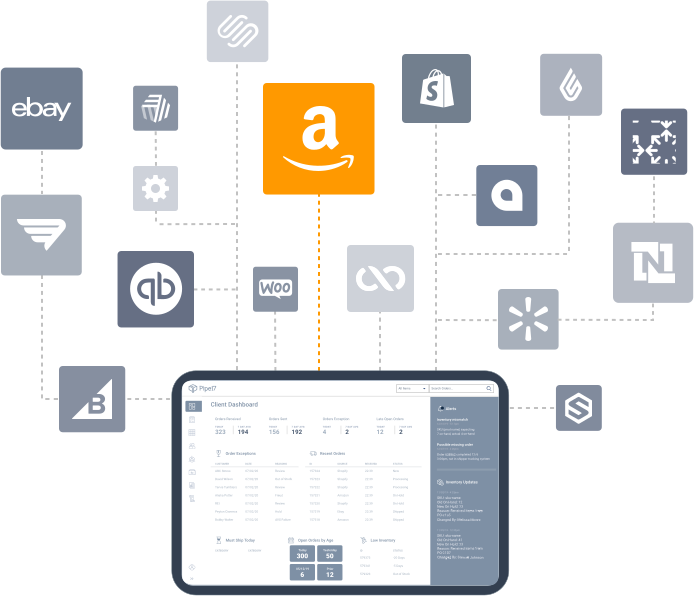
Commerce data scattered across dozens of applications makes it impossible to build comprehensive analytics or train ML models without extensive manual data engineering.
Batch exports and manual data dumps create stale analytics. By the time data reaches your data lake, operational decisions have already been made with incomplete information.
Building and maintaining custom ETL pipelines for each commerce application drains technical resources that could be focused on insights rather than infrastructure.
| iPaaS & Custom Builds | Legacy OMS | Pipe17 | |
|---|---|---|---|
| Native API-First Connectivity | ✅ | ❌ | ✅ |
| Pre-Built Commerce Connectors | ❌ | ❌ | ✅ |
| Custom Integration Mappings | ✅ | ❌ | ✅ |
| Advanced Order Orchestration | ❌ | ✅ | ✅ |
| Exception Management & Alerts | ❌ | ❌ | ✅ |
| Unified Inventory Management | ❌ | ✅ | ✅ |
| Rapid to Implement & Go-Live | ❌ | ❌ | ✅ |
| Easy to Add / Swap Channels & Flows | ❌ | ❌ | ✅ |
| Low Total Cost of Ownership (TCO) | ❌ | ❌ | ✅ |
Export events as they happen, not hours or days later. Build real-time dashboards and analytics that reflect your current operational reality, not yesterday's snapshot, reducing data latency by 95%.
Receive consistently formatted data regardless of source system. Our canonical data model simplifies analytics by standardizing how orders, inventory, and fulfillments are represented.
Eliminate the overhead of building and maintaining custom integrations. Our managed pipelines handle API changes and system updates automatically, saving 40 hours weekly on data engineering.
is better with
A commerce data lake on Amazon S3 is a central store of your raw order, inventory, fulfillment, and exception data, kept in one place so analytics, BI, and machine learning tools can query it without touching live systems. Streaming order and inventory data there gives teams a single, consistent source for reporting and modeling instead of pulling exports from each channel, ERP, and 3PL by hand. The hard part is normalization, because every source describes an order or an inventory position differently. Pipe17 solves that by standardizing all of it through the Commerce 360 Data Model™ before it lands in S3, so the data lake opens analytics-ready rather than as a pile of mismatched exports.
You stream order and inventory data to Amazon S3 with a managed connector that captures each operational event and writes it to your bucket as it happens, so there is no custom pipeline to build or maintain. Pipe17 does this across your entire stack: as orders, inventory updates, shipments, and fulfillments occur across your sales channels, ERP, WMS, and 3PLs, it captures each event, standardizes it through the Commerce 360 Data Model™, and delivers analytics-ready data to S3. The same order operations platform that routes orders from Shopify, NetSuite, and your fulfillment network feeds your data lake, so what lands in S3 reflects real operational state, not a nightly batch.
You can export the full range of order operations data, not just storefront orders: orders, inventory positions, products, shipments, fulfillments, purchase orders, transfers, arrivals, receipts, locations, and operational exceptions. Pipe17 writes each entity as structured, normalized data, so a record from Amazon looks consistent next to one from Shopify or Walmart Marketplace. Because it captures post-checkout operational events end to end, you get fulfillment performance, inventory movement, and exception data that storefront-only exports miss, giving analysts a complete picture of the order lifecycle in one S3 data lake.
Rather than building and maintaining a separate pipeline for each platform, you connect them once through a managed connector that already speaks each source's API. With Pipe17, order data from Shopify, Amazon, Walmart Marketplace, and TikTok Shop streams into the same S3 bucket in one consistent schema, so you are not reconciling field names and formats across channels downstream. New channels attach to the same model, which means adding a marketplace later does not mean another custom S3 export to engineer. This is the difference between a managed commerce connector and a generic file dump: the data arrives already aligned for analysis.
Yes. Event-driven streaming writes each order and inventory change to S3 as it happens rather than on a nightly or weekly batch, which is what keeps a data lake current enough for operational decisions instead of only retrospective reporting. Pipe17 streams on this event-driven basis and reduces data latency by up to 95%, so dashboards and models built on your S3 data reflect current reality, not yesterday's snapshot. This is the same engine behind Pipe17's real-time inventory visibility across channels, now pointed at your data lake, and it runs on multi-region AWS infrastructure with 99.99% uptime so the feed stays continuous at enterprise volume.
You centralize it by normalizing every channel, warehouse, and system into one schema, then landing that single version in a destination your analytics tools already read, like Amazon S3. The blocker is usually that each source counts orders and inventory differently, so totals never reconcile across systems. Pipe17 resolves this at the integration layer through the Commerce 360 Data Model™, the same modern order management platform that keeps inventory accurate across live selling channels. Once that normalized order and inventory data is in S3, every downstream team queries one consistent dataset instead of maintaining separate per-source extracts.
No. You can build a custom ETL pipeline or run a generic iPaaS, but both pull raw fields from each API and leave normalization, and ongoing maintenance, to you; when a source like Shopify changes its API, the pipeline breaks. A managed commerce connector avoids that. Pipe17 maintains every connector in its managed commerce network as upstream APIs change, normalizes all sources through one canonical model, and delivers consistent data to S3, removing the engineering overhead of a general-purpose iPaaS or custom build and saving teams roughly 40 hours a week.
Pipe17 writes order and inventory data to your S3 bucket as structured JSON files, normalized through the Commerce 360 Data Model™ so every record follows a consistent schema regardless of source system. This is the same normalized output Pipe17 delivers to destinations like Snowflake, so an order from one channel uses the same fields as an order from another. You control the destination bucket and can target a specific folder within it as the export root. Because normalization happens before data lands in S3, the datasets are query-ready for analysis in Athena, Redshift, or any tool in your AWS environment.
Pipe17 writes normalized, query-ready files to S3 that load directly into Amazon Athena, AWS Glue Data Catalog, and Amazon Redshift Spectrum with no preprocessing. Each data flow lands in its own logical area (orders, inventory, fulfillments, exceptions, and so on), so it maps cleanly to tables in your AWS query layer and to date-partitioned data lake patterns. For lakehouse architectures built on Apache Iceberg, Delta Lake, or Amazon S3 Tables, Pipe17's normalized output feeds those managed table formats downstream, and because every record already conforms to the Commerce 360 Data Model™, that step needs no per-source mapping work.
Both. Pipe17 starts writing events to your S3 bucket the moment the connector goes live, and the implementation team can also seed the bucket with historical data from your upstream systems during onboarding. Order history from channels like Shopify, Amazon Seller Central, and NetSuite can be backfilled to the depth each source API exposes, so your S3 data lake opens with a usable baseline for trend analysis and model training rather than starting empty on day one. You scope the backfill window per data flow during kickoff, so the historical depth matches what each analytics or ML use case actually needs.
Yes. Operational data from across Amazon's ecosystem streams into S3 normalized alongside every other channel you sell and fulfill through. That includes marketplace orders from Amazon Seller Central and Amazon Vendor Central, plus fulfillment data from Amazon MCF, FBA, and FBM. Pipe17 normalizes this Amazon data through the same canonical model it applies to your other channels and 3PLs, so analysts compare channel performance without manual mapping. Pipe17 Order Hub is also available on AWS Marketplace, so feeding S3 fits an existing AWS environment with consolidated billing.
Yes, normalized order and inventory data in S3 is structured for machine learning and AI workloads such as demand forecasting, inventory optimization, and customer behavior modeling. Clean, consistent datasets remove the feature-engineering overhead that raw, source-specific exports create. Exception data streamed to S3 also supports root-cause analysis and anomaly detection across your operation. Beyond the data lake, Pipe17 runs AI-native operations directly: Pippen AI answers natural-language questions about live order operations, and an onX-compliant MCP server lets AI agents query orders, inventory, and fulfillments without custom integration work.
Yes, Amazon S3 is one of several destinations Pipe17 supports. The same normalized order and inventory data can stream to Snowflake or Google Cloud Storage, which feeds BigQuery, Looker, and Vertex AI downstream. Because every destination receives data through the Commerce 360 Data Model™, you can run S3 as your data lake while another team consumes the same operational data in a separate warehouse, with no duplicate engineering. This lets enterprise data teams standardize commerce data once and distribute it to whichever analytics environment each group already uses.
Pipe17 writes to your S3 bucket using IAM credentials your team controls, scoped to the exact bucket and path you designate, so it never reads or writes anything else in your AWS account. Data is encrypted in transit over TLS, and at-rest encryption follows your own bucket policy, whether SSE-S3, SSE-KMS, or customer-managed keys, so every object Pipe17 writes inherits the standard your security team already enforces. Because access is governed by your IAM policies and keys rather than credentials Pipe17 holds, the connector fits cleanly into existing AWS security reviews and least-privilege models.
Yes. Pipe17 can obfuscate personally identifiable information before it lands in S3, so analytics and ML teams work with order and shipment data without raw customer identifiers entering the data lake. You choose which fields to mask per data flow, so high-cardinality keys needed for joins stay usable while names, addresses, and contact details are scrubbed. The same control is available on other destinations like Snowflake, which matters for teams managing GDPR, CCPA, or internal governance policies where the analytics environment sits outside the boundary cleared for PII.
The Amazon S3 connector activates in days once your destination bucket and AWS credentials are in place, since there is no pipeline to build or schema to hand-engineer. Pipe17 runs on multi-region AWS infrastructure with 99.99% uptime, SOC 2 Type 2 compliance, and support for your own SSO, so the data feed meets enterprise security and reliability requirements. The connector streams at the scale of millions of orders a day per organization without scheduled downtime. Pipe17 is built for enterprise commerce operations; teams that only need to export storefront data from a single channel may find a lighter-weight tool sufficient.