Managing inventory and orders across ShipBob's distributed fulfillment network while selling on multiple channels creates operational complexity that native integrations cannot address.
Stock scattered across facilities without intelligent allocation leads to split shipments and higher costs.
Orders route quickly to warehouses, but cancellations process slowly. This timing gap creates unnecessary shipments and returns.
| iPaaS & Custom Builds | Legacy OMS | Pipe17 | |
|---|---|---|---|
| Native API-First Connectivity | ✅ | ❌ | ✅ |
| Pre-Built Commerce Connectors | ❌ | ❌ | ✅ |
| Custom Integration Mappings | ✅ | ❌ | ✅ |
| Advanced Order Orchestration | ❌ | ✅ | ✅ |
| Exception Management & Alerts | ❌ | ❌ | ✅ |
| Unified Inventory Management | ❌ | ✅ | ✅ |
| Rapid to Implement & Go-Live | ❌ | ❌ | ✅ |
| Easy to Add / Swap Channels & Flows | ❌ | ❌ | ✅ |
| Low Total Cost of Ownership (TCO) | ❌ | ❌ | ✅ |
Automatically select the best ShipBob location for each order. Consider inventory, cost, and delivery speed simultaneously, improving delivery times by 25%.
Maintain accurate inventory across ShipBob's entire network with adaptive synchronization that handles peak volumes. Automatically update your selling channels and ERP in real-time to prevent overselling while maximizing inventory productivity.
Stop orders immediately when customers cancel. Prevent unnecessary shipments with real-time updates, preventing 95% of unwanted shipments.
is better with
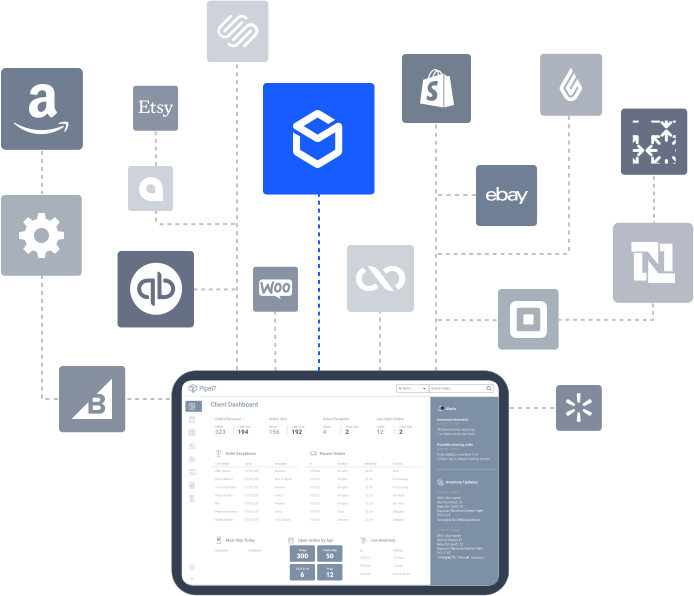
The Pipe17 ShipBob integration connects ShipBob's global fulfillment network to your selling channels and back office through Pipe17, the AI-Native OrderOps Platform and a modern enterprise order management system. Orders flow in from channels like Shopify and Amazon, and Pipe17 pushes each shipment to the right ShipBob fulfillment center, pulls fulfillments, tracking, and inventory back, and keeps every channel and ERP in sync in real time. ShipBob runs the warehouses and carriers; Pipe17 orchestrates the orders, inventory, and exceptions across ShipBob and any other fulfillment locations you operate.
ShipBob runs your fulfillment, but it is not an order management system. The moment you sell across more than one channel, hold inventory in more than one location, or add a second 3PL, you need a layer that decides where each order ships, keeps inventory accurate everywhere you sell, and manages holds, cancellations, and returns. That is what an OMS does. Pipe17 is a modern enterprise order management system that sits above ShipBob and the rest of your stack and orchestrates orders and inventory across every channel and location, while ShipBob keeps handling the picking, packing, and shipping. If you sell on a single store and ship only from ShipBob, ShipBob's native tools may be enough; once you go multi-channel or multi-location, an OMS is what keeps the whole operation accurate.
ShipBob's native integrations move orders and tracking between ShipBob and a single store or marketplace, and they do that well. The limits show up as you scale, because native connections are point-to-point: on their own they do not orchestrate routing across multiple fulfillment locations, maintain one inventory source of truth across channels and non-ShipBob warehouses, run advanced order routing and exception handling, or post cleanly into an ERP for financial reconciliation. Pipe17 complements ShipBob by adding the order management and inventory layer on top, so you keep ShipBob's fulfillment strengths and gain orchestration across your whole operation as you add channels, locations, and back-office systems.
No, Pipe17 does not replace ShipBob, and it is not just a ShipBob connector; it is the modern enterprise order management system around it. ShipBob stays your fulfillment provider, with a global network of 60+ fulfillment centers and more than one billion units fulfilled to date, while Pipe17 owns the order lifecycle above it. As order management software that replaces legacy and custom-built OMS platforms, Pipe17 adds omnichannel order orchestration, intelligent order routing, real-time inventory control, product and catalog sync, delivery promising, and exception handling across ShipBob and the rest of your network. Orders from every channel land in one system that decides where each ships, instead of a point-to-point sync that only moves data between two apps.
Yes. ShipBob can fulfill from multiple sales channels and ship from its 60+ fulfillment centers, and Pipe17 turns that into true multi-channel and omnichannel order orchestration. Orders from Shopify, Amazon, and 300+ other channels — plus retail, wholesale, and marketplace orders — flow into one system that routes each to the best ShipBob location, holds a single inventory pool behind every channel, and can also route to other 3PLs or your own warehouses when that serves the customer better. So a ShipBob brand that starts in DTC can add retail and B2B/wholesale without standing up a separate fulfillment stack for each channel, running it all as one connected order operation.
Pipe17 gives you multi-location inventory management from a single, real-time source of truth across ShipBob's fulfillment centers, other 3PLs, and your own warehouses, then propagates accurate counts to every selling channel and ERP within minutes. Event-based updates, not slow batch syncs, keep stock accurate as ShipBob ships orders and posts receipts, so you sell against true availability instead of stale counts. This removes the double-counting and phantom stock that happen when inventory sits scattered across facilities, and it lets you sell one pool of inventory across Shopify, Amazon, and wholesale while writing fulfillment and tracking back to each channel.
Out-of-sync ShipBob inventory usually comes down to batch updates and point-to-point connections: each channel polls ShipBob on its own schedule, so counts drift between syncs and oversells slip through during peak periods. Pipe17 fixes this by becoming the single source of truth and pushing event-based updates the moment ShipBob stock changes, so available counts update across your Shopify store, Amazon, eBay, and TikTok Shop within minutes rather than hours. Because every channel reads from the same real-time picture instead of syncing to ShipBob independently, the race conditions that cause overselling go away — and you can hold or pre-sell specific SKUs with rules, releasing them automatically when ShipBob receives replenishment.
Pipe17's order orchestration routes each order to the optimal ShipBob fulfillment center or alternate provider by weighing inventory availability, shipping cost, and delivery speed at once — brands cut shipping costs by up to 30% and improve delivery times by around 25% versus defaulting to one facility. Through Pipe17's managed commerce network of pre-built connectors, the same rules engine can split, consolidate, or re-route orders across ShipBob, other 3PLs like Radial or Amazon MCF, warehouse management systems like Manhattan WMS, and your own distribution centers; Wyze, for example, improved click-to-delivery speed by more than 50%. If the best location is out of stock or ShipBob rejects a shipment, Pipe17 applies the fallback rules you set and re-routes automatically, surfacing any exception on the dashboard before it reaches the customer.
Yes, Pipe17 connects ShipBob to NetSuite, Acumatica, and other ERPs, posting fulfillment, shipment, and inventory data back for financial reconciliation. As ShipBob ships an order, Pipe17 writes the fulfillment and tracking to your selling channels and records the transaction in your ERP, keeping revenue, inventory, and the general ledger aligned. It also manages SKU mappings and bundle handling, so kitted products fulfilled by ShipBob reconcile correctly against the catalog in your ERP.
Yes. Pipe17 is an AI-Native OrderOps Platform, so AI works against live ShipBob data rather than stale exports. Pippen AI writes and tunes the rules that route orders to the right ShipBob fulfillment center, and a Pipe17 MCP server exposes real-time ShipBob inventory and fulfillment status to AI agents and agentic commerce channels, which can place, check, or adjust orders like any other channel. AI recommends routing and inventory changes across ShipBob and your other locations while your team stays the approver, so your rules remain the source of truth.