
Connecting RyderShip to multiple ERPs, commerce platforms, and marketplaces requires extensive IT resources and creates a web of point-to-point integrations.
Managing inventory and orders across multiple Ryder facilities while maintaining accuracy requires sophisticated orchestration that manual processes cannot deliver.
Enterprise operations require detailed tracking, compliance documentation, and real-time visibility that disconnected systems struggle to provide consistently.
| iPaaS & Custom Builds | Legacy OMS | Pipe17 | |
|---|---|---|---|
| Native API-First Connectivity | ✅ | ❌ | ✅ |
| Pre-Built Commerce Connectors | ❌ | ❌ | ✅ |
| Custom Integration Mappings | ✅ | ❌ | ✅ |
| Advanced Order Orchestration | ❌ | ✅ | ✅ |
| Exception Management & Alerts | ❌ | ❌ | ✅ |
| Unified Inventory Management | ❌ | ✅ | ✅ |
| Rapid to Implement & Go-Live | ❌ | ❌ | ✅ |
| Easy to Add / Swap Channels & Flows | ❌ | ❌ | ✅ |
| Low Total Cost of Ownership (TCO) | ❌ | ❌ | ✅ |
Connect any system to RyderShip without custom development. Reduce integration costs by 85% while maintaining enterprise security and compliance standards.
Orchestrate operations across all Ryder locations seamlessly. Optimize inventory placement and routing to reduce logistics costs by 25% automatically.
Track every shipment, inventory movement, and return in real-time. Provide stakeholders with instant access to KPIs that drive better decisions.
is better with
RyderShip connects to your entire commerce stack through Pipe17's dedicated connector, which links Ryder's ecommerce fulfillment platform to your sales channels, ERPs, and back-office systems. Pipe17 and RyderShip have partnered since 2023, so joint customers automate order, fulfillment, inventory, product, and return flows between RyderShip and hundreds of selling channels and back-office systems without custom code. The connector is part of Pipe17's managed commerce network, maintained as partner APIs change, and Pipe17 acts as the modern enterprise order management system (OMS) and inventory layer around your Ryder fulfillment operation.
Pipe17 is a modern enterprise order management system (OMS) built to sit on top of Ryder fulfillment and the rest of your commerce stack. Unlike custom point-to-point integrations that break when partner APIs change, or an aging legacy OMS that was never built for modern multi-channel commerce, Pipe17 gives you pre-built, managed connectivity to Ryder, real-time order management and inventory accuracy, and business-user control over routing rules, at a lower total cost of ownership. Brands reduce integration costs by 85%.
Pipe17 syncs more than a dozen bidirectional data flows between RyderShip and your systems. Outbound to Ryder facilities, it pushes arrivals (ASNs with compliance documentation), product masters, shipping labels, return instructions, and order cancellations. Inbound from RyderShip, it pulls fulfillments, inventory updates, facility locations, receiving confirmations with variance reporting, return dispositions, and shipment data including proof of delivery. Every flow maps into your order management so orders, inventory, and returns stay accurate across each channel and your NetSuite ERP.
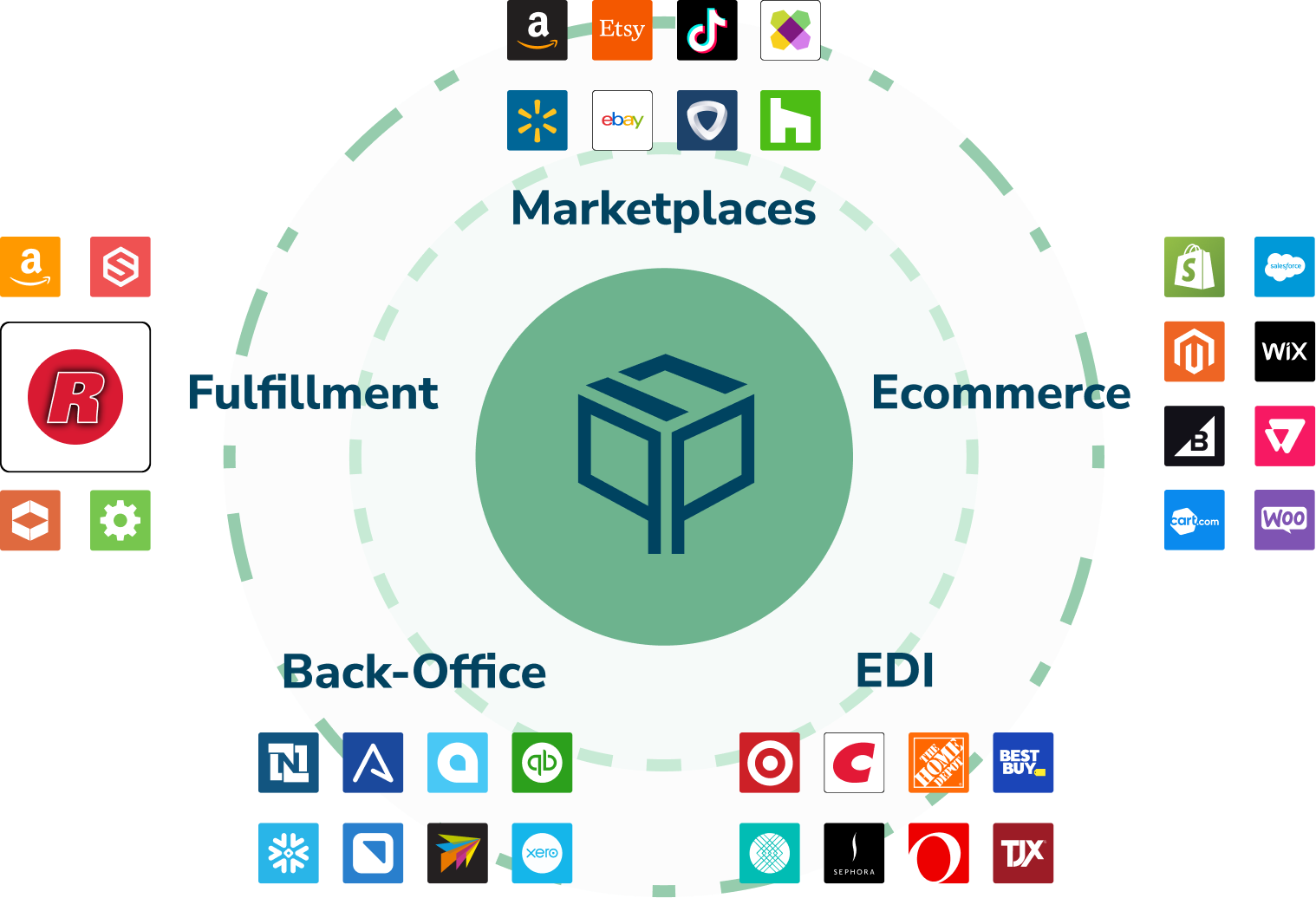
Pipe17 connects RyderShip to ERPs, ecommerce platforms, marketplaces, and back-office applications through one managed network. RyderShip customers running an ERP such as NetSuite, Acumatica, or ApparelMagic can bidirectionally sync inventory, products, orders, and returns with their Ryder fulfillment. On the sell side, Pipe17 links Ryder fulfillment to storefronts like Shopify and to marketplaces, so demand from every channel flows to RyderShip automatically. Data lakes and accounting systems connect the same way.
Pipe17 is a modern enterprise order management system (OMS) that replaces custom point-to-point builds and legacy OMS platforms, so most brands roll out in phases rather than one long project. The RyderShip connector itself activates in hours once credentials and facility details are in place, because it is pre-built and maintained by Pipe17 rather than coded from scratch. Teams configure routing rules, inventory sync, and return flows in a no-code order management interface, then add channels and systems on their own timeline using Pipe17's managed network. There is no systems-integrator dependency for changes.
Pipe17 maintains a single, real-time inventory picture across every Ryder facility, your own warehouses, and other fulfillment locations. It pulls inventory from RyderShip incrementally and propagates changes to all connected channels in real time, so you always know what you can sell. Event-based order management inventory sync prevents overselling and underselling, reduces buffer stock, and eliminates the double-counting that batch updates cause. For brands distributing across multiple Ryder locations, Pipe17's order operations platform keeps availability accurate everywhere customers buy.
Yes, Pipe17's dynamic order routing sends each order to the optimal location, whether that is a Ryder facility, your own warehouse, or another 3PL, based on real-time inventory and business rules. Orders can split across locations, reroute automatically when a node rejects them, and support omnichannel models like ship-from-store and BOPIS. This is core order management functionality: one order, multiple fulfillment types, routed without manual work. Brands running Radial or Amazon MCF alongside Ryder orchestrate every node from one platform.
Pipe17 automates returns in both directions with RyderShip and keeps your ERP in sync at every step. It pushes RMA information with handling and inspection requirements to Ryder facilities and pulls return completions back, including condition assessments and disposition decisions, then writes those updates to your inventory and to ERPs like NetSuite so every restock, refund, and write-off posts to the correct location and your books stay accurate. Pipe17 also connects dedicated returns platforms such as Loop and Happy Returns to your Ryder fulfillment, giving customers a smooth returns experience while operations and finance keep one accurate record in order management.
When Ryder fulfills an order, Pipe17 pulls the fulfillment data from RyderShip and updates your ERP and finance workflows automatically. Pipe17 can trigger invoicing, revenue recognition, and reconciliation in systems like NetSuite or Acumatica. It also streams order, inventory, and fulfillment data to data lakes such as Snowflake, Amazon S3, and Google Cloud Storage for reporting and analytics. Finance, operations, and analytics work from the same accurate record instead of manual exports.
Yes, Pipe17 routes orders from every channel to Ryder fulfillment, including direct-to-consumer storefronts and marketplaces. Demand from Shopify, TikTok Shop, Walmart Marketplace, and other channels flows into RyderShip automatically, with tracking and inventory synced back to each channel. Ryder is ready to handle TikTok Shop fulfillment, and Pipe17 makes that channel work like any other. Brands manage all of it through one order management view rather than channel by channel.
Yes, enterprise brands and leading fulfillment providers run their order operations on Pipe17. Beauty leader e.l.f. Beauty runs its multi-brand portfolio across Shopify, TikTok Shop, and multiple fulfillment partners on Pipe17's order operations layer. Among fulfillment providers, Radial cut brand onboarding from 18 weeks to one week, Barrett Distribution onboards DTC brands faster while cutting IT load, and Mobix scaled 3X with 85% lower costs. The same platform that supports these operations connects your Ryder fulfillment to every channel and system.
Pipe17 runs on an event-driven, multi-region AWS architecture with 99.99% uptime, so order, inventory, and fulfillment data propagates in real time at high volume. Because the RyderShip connector is part of Pipe17's managed network, Pipe17 updates it as Ryder's APIs evolve, so the integration does not break and your team does not maintain it. Pipe17 is also agentic-commerce ready: its onX-compliant MCP server exposes inventory, order capture, and fulfillment to AI agents through a standard interface, with no custom work required.